

Publishers should focus on publishing original and creator-led content on social media to boost audiences and advertising revenue, according to DMG New Media, the social publishing arm of the Daily Mail.
Hannah Blake, commercial managing director at DMG New Media (formerly DMG Media and DMG Creator Media), told Press Gazette that news-based content is harder to monetise and less likely to engage viewers.
DMG New Media produces content for brands including Mail Sport, Mail on Sunday’s You magazine, specialist channels including entertainment brand The Spotlight, Metro and Metro Entertainment. Its social channels have more than 150 million followers combined.
DMG New Media launched in October last year and is “doubling down” on reaching young people and expanding its advertising opportunities with 25 full time in-house creators and a direct sales team of seven.
[Read more: Mail invests heavily in creating content for Tiktok and Instagram]
At what point did DMG New Media decide to focus on creator content?
DMG New Media’s saw a boost in engagement among young audiences and brand sponsorships when it closed the website of its in-house fashion and beauty brand Eliza in 2025, having launched it only a few years earlier, and turned it into a social-only brand.
“We felt that it was a really big opportunity to apply that to the rest of the business,” said Blake. “So we’ve certainly gone through a big change in terms of shifting our content strategy, so it’s not just about mass scale and reach, but actually about creating original content and putting faces in front of the camera rather than just clips of the news.”
Why should publishers invest in creator-led content?
DMG New Media discovered it “had to adapt” once it realised that content creation was where the audience and revenue was going, said Blake.
“We could see that there was a massive shift in the industry and how audiences were behaving. You could see particularly amongst young people… they’re spending more and more time on social platforms rather than owned and operated platforms and websites, and I think now over 50% of young people get their news from social.”
About 65-70% of the audience across Tiktok and Instagram on Daily Mail, Daily Mail UK and Mail Sport are Gen Z.
Blake added that creators have become “incredibly influential” in purchasing decisions. “I think over 70% of people now make purchasing decisions based on a content creator recommendation… you’re starting to see lots of advertising money move that way.”
She added it’s “quite critical” for publishers to move into this space.
How can smaller publishers build audiences on social media?
Blake said publishers don’t need huge budgets to kickstart success in content creation, but they do need focus.
“If you look at an individual content creator, you don’t need a lot of money to start a page,” she said.
“You’ve got lots of individual people doing it, but I think to put a lot of power behind it it does need lots of focus. So, I think you do need like a dedicated team and a dedicated function and a big vision on it of where you want to take it.”
She added that a large team isn’t necessary, as a publisher can get “a week’s worth of content from” just one video, which can create multiple clips and subtitled screenshots for an Instagram carousel.
“From one shoot, can you get many pieces of content that you can cut up in different ways,” she said.
Once content is resonating, they will need to put investment behind this to “blow it up”, Blake added.
How are you balancing marketing content and news content?
Branded content is “a small proportion” of overall content put out on social platforms by DMG New Media, said Blake, “but it’s certainly a really big revenue opportunity for us”.
Blake said that while “all layers of our content strategy can be monetised”, most branded work takes place outside of news-based content.
However breaking news can be used as a jumping off point for follow-up pieces with partnered brands.
“We’re not necessarily monetising [news] as it goes out, but we are then pitching to clients like, look how impactful these formats are for telling stories, what story do you want to tell?”
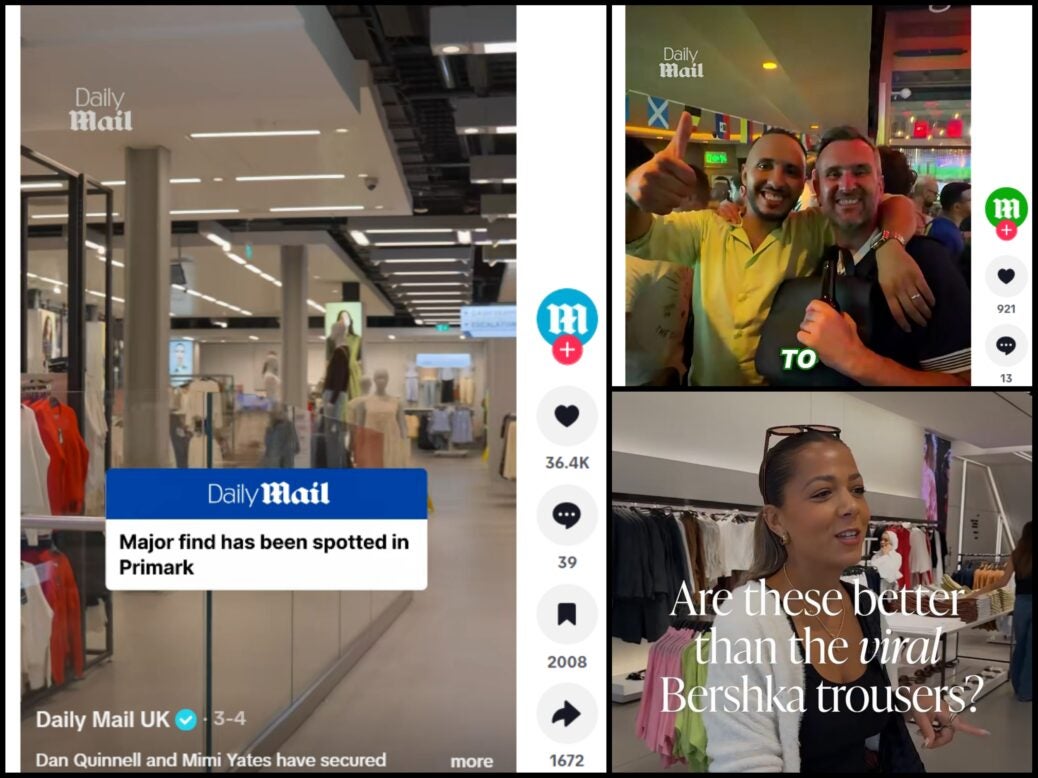
DMG New Media delivers a breaking news format with partners such as Primark: “We set them up like a spoof news series on news just in,” said Blake. “Primark’s dropped its latest co-ord in store. Mimi’s on the ground reporting from in-store.”
Blake added that audiences to entertainment and lifestyle shows are “more likely to click on something”.
“And so if an advertiser wants a click-based outcome we might funnel them more to those types of content,” she added.
“I think our job is to make the partnered content just as engaging as the non-partnered content. I mean, that’s why brands want to work with us, to be able to tap into our expertise of knowing that we will be able to create them something that’s really impactful for our audience,” said Blake.
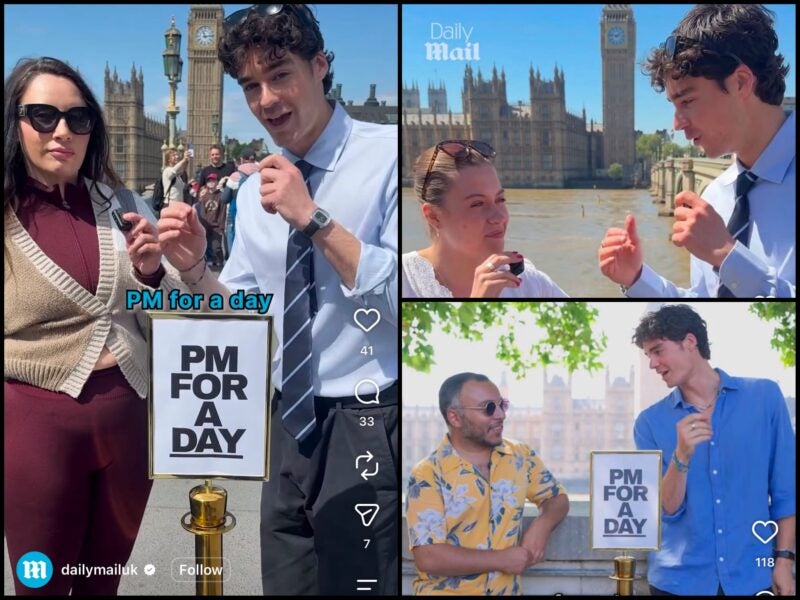
Other news-based features are created without a commercial link, such as the Daily Mail’s “PM for the day” series which sees members of the public interviewed on what they’d change about politics today.
How does DMG New Media get paid by content platforms?
DMG New Media gets “very little” money from Instagram and Tiktok ad revenue shares, though the company is currently “in conversation with the platforms about monetising via their ad products”.
“We are speaking all the time to the platforms about how we can also tap into some other monetisation opportunities through their own platform ad products because the amount of volume of views that we drive on the platform – it feels that there should be an opportunity for us to do that too.”
Most revenue comes from partnered deals, said Blake.
“When we create a show, for example, we can sell like a full ten-part series to an advertiser, which will command big six-figure numbers.”
DMG New Media has a dedicated sales team of seven who sell content partnerships to agencies and clients, but it recommends utilising content creators for sales purposes.
“I do think you need a team dedicated to selling [partnerships], they need to understand the platform and the content, and they need to speak to clients in a way that will help them understand the vision of how they can integrate into it,” said Blake.
“What I would say though is we find a lot of success with our content creators selling for us as well… they speak to the clients because the clients are buying into them.”
What makes a successful content creator team for a publisher?
“One of the interesting things when we hire content creators – we’re not asking for their CV,” said Blake, adding that content creators are scouted on platforms.
Those hired tend to be people who create resonating content, “live and breathe” the platforms and can “build some kind of community”, said Blake.
“I think as a publisher, our opportunity is to catch people before they break. You want to catch someone in their infancy where they’re showing potential,” she added.
Blake said there is a “challenge” in hiring a creator that is “already very established”, as they tend to be expensive and busy.
“We’ve been attracting people who maybe have got their first 1,000 followers, they’ve got some real potential in terms of what they’re creating.”
What makes a popular video for a publisher?
“One of the things we obsess over is formats and repeatable formats,” said Blake, adding this means “episodic in nature” and “follows a formula” so that audience recognise it as soon as they scroll past it.
“Things like PM for a day – it’s really easy. It’s a really visual opener. There’s a sign that says ‘PM for a day’.”
She added giving the audience something they recognise over time such as a theme tune or props gives a visual or audio cue to content.
“Then you’ve hooked people in. So yeah, that repeatable show is what I’d be looking for.”
She added beyond this a publisher needs to tap into “what’s culturally interesting”.
For example, moving beyond sport reporting and following fan stories instead, said Blake.
“We followed a fan who travelled the length of a country to go and see his favourite team the day before his wedding… It’s those stories that people engage with and they want to interact with, rather than just talking about what happened at the game.”
Blake added that frequency of posting doesn’t matter as long as it’s consistent.
“You just have to feed a regularity and a consistency to the algorithm,” she said. “But I don’t think levels of volume is that significant. It may help you grow quicker, especially on Tiktok. But I don’t think it’s significant as people think.”
How are staff incentivised?
One reason staff are “highly motivated” is the instant feedback they receive from social videos.
“What’s so great is on social you can see instantly the performance of that content and you can interact with the audience. So, the content creators love that direct feedback.”
Blake added the commercial side of the business also motivates staff.
“They are aware of our commercial targets, and they’re aware that they need to make this a successful business. So, they get just as involved in the commercial side as they do the content side.”
What are the primary reasons for DMG New Media’s social media success?
“I obsess over things like average watch times of content and engagement rates, and they’re incredibly high. Some of the shows that we’re putting out have got 30-second, 40-second watch times, engagement rates of 10% – real industry-busting times and engagement rates,” said Blake.
Presenting itself as a “modern social publisher – not just a social publisher” has also helped its success.
“This is a new world of social where followers don’t mean much anymore, because most people see accounts that they don’t follow in their feed,” said Blake, adding the percentage of returning viewers is more important.
“It’s no longer the days of just clipped up memes and distributed content. We’re now in a world of original shows, repeat formats, and IP, and you’ve got all these young content creators who are commanding a huge amount of audience, so creative marketing has blown up, and creators need to be front and centre of strategy.”
What are the biggest mistakes to watch out for in content creation?
“Being boring,” said Blake. “You’ve got to catch people’s attention and challenging yourself to create something [like] would I stop and give up my precious time to watch this?”
Blake added the second common mistake is not thinking about the audience.
“What’s interesting to the audience, and what do they want to hear from us?”
She added: “I think sometimes the mistake is holding on to things for too long and trying to make everything perfect and publishing it, and it flops. You’ve got to get quite a lot of volume out to get the data back to then learn something to iterate and to guide your content decisions.”
Blake also advised publishers do not replicate content that exists on their site or in print.
“It’s a very crowded market. Everybody is talking about everything. So, what is unique about what you bring, and who are you speaking to?”
Blake said DMG’s You Magazine learned to “un-attach” its social page from print after posting print content such as magazine front covers.
“Try not to be like a carbon copy of what’s come before.”
Email pged@pressgazette.co.uk to point out mistakes, provide story tips or send in a letter for publication on our "Letters Page" blog
